






Innovation has become a defining factor in how organizations compete, adapt and grow in rapidly changing markets. Advances in technology, evolving customer expectations and increasing competitive pressure have made traditional planning models less effective. As a result organizations must move beyond reactive innovation toward structured, intentional approaches.

Innovation strategy insights provide the clarity needed to navigate this complexity. Rather than treating innovation as a series of isolated initiatives, an innovation strategy connects ideas, capabilities and execution to long term business objectives. This article explores how organizations develop, evaluate and apply innovation strategy insights to achieve sustainable growth and strategic resilience.
What Are Innovation Strategy Insights?
Innovation strategy insights refer to structured understandings that guide how organizations plan, prioritize and execute innovation. These insights combine strategic intent, organizational capability and market awareness to ensure innovation efforts deliver measurable value.
Unlike ad hoc innovation, a well defined strategy focuses on alignment. Innovation strategy insights help organizations determine where to innovate, how to innovate and why innovation matters within their broader business context. This approach reduces wasted effort and improves long term impact.
Why Innovation Strategy Matters in Modern Organizations
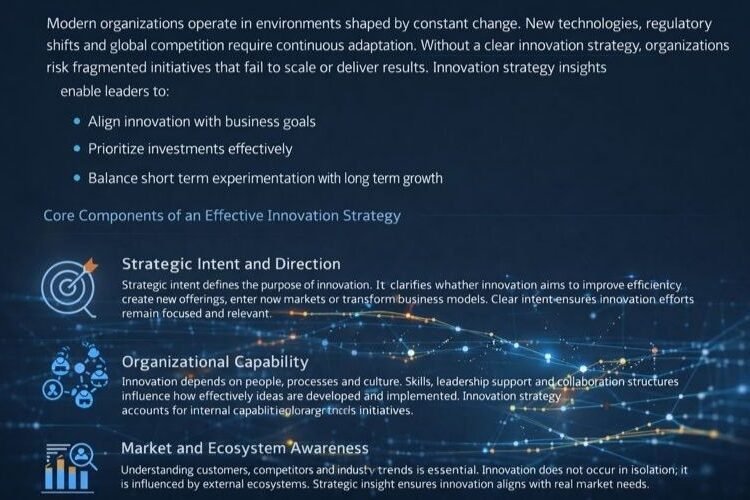
Modern organizations operate in environments shaped by constant change. New technologies, regulatory shifts and global competition require continuous adaptation. Without a clear innovation strategy organizations risk fragmented initiatives that fail to scale or deliver results.
Innovation strategy insights enable leaders to:
- Align innovation with business goals
- Prioritize investments effectively
- Balance short term experimentation with long term growth
By integrating innovation into strategic planning organizations improve resilience and decision making consistency.
Core Components of an Effective Innovation Strategy
A successful innovation strategy is built on multiple interconnected components. Each component plays a role in shaping how innovation is conceived, evaluated and executed.
Strategic Intent and Direction
Strategic intent defines the purpose of innovation. It clarifies whether innovation aims to improve efficiency, create new offerings, enter new markets or transform business models. Clear intent ensures innovation efforts remain focused and relevant.
Organizational Capability
Innovation depends on people, processes and culture. Skills, leadership support and collaboration structures influence how effectively ideas are developed and implemented. Innovation strategy insights account for internal capabilities before scaling initiatives.
Market and Ecosystem Awareness
Understanding customers, competitors and industry trends is essential. Innovation does not occur in isolation; it is influenced by external ecosystems. Strategic insight ensures innovation aligns with real market needs.
Key Dimensions of Innovation Strategy
Before exploring execution, it is important to understand the key dimensions that shape innovation strategy. The table below outlines these dimensions and their strategic relevance.
Key Dimensions of Innovation Strategy
| Dimension | Description | Strategic Importance |
| Strategic Alignment | Connection to business goals | Ensures relevance and focus |
| Capability Readiness | Skills and resources available | Determines execution success |
| Risk Management | Approach to uncertainty | Balances experimentation and stability |
| Governance Structure | Decision making framework | Maintains consistency and accountability |
| Measurement Metrics | Performance evaluation | Enables continuous improvement |
Together, these dimensions form a structured foundation for innovation. Organizations that address each dimension systematically are better positioned to translate innovation ideas into sustainable outcomes.
Strategic Innovation Planning and Execution
Strategic innovation planning involves converting insight into action. It requires structured processes that guide idea generation, evaluation and implementation. Without planning discipline, even strong innovation strategy insights may fail to deliver value.
Execution success depends on prioritization. Organizations must decide which initiatives receive funding, leadership attention and operational support. Clear criteria reduce bias and improve resource allocation.
Aligning Innovation with Business Objectives
Alignment is one of the most critical aspects of innovation strategy. Innovation initiatives that operate independently of business objectives often struggle to gain traction or justify investment.
Innovation strategy insights help organizations align innovation portfolios with:
- Growth targets
- Efficiency goals
- Customer experience priorities
This alignment improves leadership confidence and organizational commitment to innovation efforts.
Innovation Governance and Decision Making
Governance structures define how innovation decisions are made. This includes who approves initiatives, how risks are managed and how progress is reviewed.
Effective governance does not restrict creativity. Instead, it provides clarity and consistency, enabling faster decision making and reducing uncertainty. Innovation strategy insights inform governance by clarifying priorities and evaluation criteria.
Innovation Governance Models and Their Impact
Different governance models influence how innovation scales. The table below compares common governance approaches and their strategic implications.
Innovation Governance Models
| Governance Model | Characteristics | Strategic Impact |
| Centralized | Decisions made by leadership | Strong alignment, slower experimentation |
| Decentralized | Teams innovate independently | Faster ideas, higher fragmentation risk |
| Hybrid | Central strategy with local execution | Balance of control and flexibility |
| Portfolio Based | Initiatives evaluated collectively | Optimized investment allocation |
Selecting the appropriate governance model depends on organizational size, culture and strategic objectives. Innovation strategy insights guide this selection by aligning governance with long term goals.
Measuring Innovation Performance
Measurement is essential for sustaining innovation. Without clear metrics organizations cannot determine whether innovation initiatives deliver value or require adjustment.
Common innovation performance indicators include:
- Time to market
- Adoption rates
- Revenue contribution
- Operational impact
Innovation strategy insights ensure measurement focuses on outcomes rather than activity volume.
Innovation Risk Management and Uncertainty

Innovation inherently involves uncertainty. New ideas carry technical, market and execution risks. Effective innovation strategies acknowledge these risks and manage them proactively.
Risk management does not eliminate uncertainty but reduces its impact. Structured experimentation, phased investment and continuous feedback are essential tools supported by innovation strategy insights.
Building Long Term Innovation Capability
Sustainable innovation requires continuous capability development. Skills, tools and processes must evolve alongside strategy.
Organizations that invest in learning, collaboration and leadership development create environments where innovation becomes repeatable rather than occasional. Innovation strategy insights support this by identifying capability gaps and development priorities.
Innovation Strategy Insights for Leadership
Leadership plays a central role in shaping innovation outcomes. Leaders influence priorities, culture and resource allocation.
Innovation strategy insights equip leaders with:
- Clear decision frameworks
- Shared innovation language
- Confidence in long term planning
This enables consistent messaging and stronger organizational alignment.
Common Challenges in Innovation Strategy
Despite best intentions organizations face challenges when implementing innovation strategies. Common issues include unclear priorities, resistance to change and insufficient governance.
Innovation strategy insights help address these challenges by providing structure and clarity. When insights are embedded into planning and execution organizations reduce fragmentation and improve consistency.
Innovation Strategy in Different Organizational Contexts
Innovation strategies vary by industry, size and maturity. Startups may focus on rapid experimentation, while established enterprises prioritize scalability and risk management.
Innovation strategy insights allow adaptation without losing strategic coherence. This flexibility supports innovation across diverse organizational contexts.
The Role of Innovation Strategy in Long Term Growth
Long term growth depends on the ability to adapt. Innovation strategies ensure organizations remain relevant as markets evolve.
By integrating innovation into strategic planning organizations shift from reactive change to proactive growth. Innovation strategy insights support this transition by aligning vision, capability and execution.
Conclusion
Innovation is no longer optional for organizations seeking long term success. However, innovation without strategy often leads to inefficiency and missed opportunity.
Innovation strategy insights provide the structure needed to align innovation with business objectives, manage risk and build sustainable capability. By applying these insights organizations strengthen decision making, improve execution and position themselves for continuous growth in dynamic environments.
Frequently Asked Questions (FAQs)
What are innovation strategy insights?
Innovation strategy insights are structured understandings that guide how organizations plan, prioritize and execute innovation. They connect innovation efforts to business objectives, organizational capabilities and market conditions to ensure long term value creation.
Why is innovation strategy important for businesses?
Innovation strategy is important because it aligns innovation initiatives with strategic goals, reduces wasted investment and improves execution consistency. It helps organizations manage risk while pursuing growth and adaptation.
How do organizations develop innovation strategy insights?
Organizations develop innovation strategy insights through strategic analysis, market research, capability assessment and leadership alignment. These insights evolve through continuous evaluation and learning.
What role does leadership play in innovation strategy?
Leadership sets direction, allocates resources and reinforces culture. Strong leadership ensures innovation strategy insights are embedded into decision making and organizational priorities.
How is innovation performance measured?
Innovation performance is measured using metrics such as adoption rates, time to market, revenue impact and operational improvement. Effective measurement focuses on outcomes rather than activity volume.
Can innovation strategy apply to small organizations?
Yes. Innovation strategy principles apply to organizations of all sizes. Smaller organizations adapt the approach to their scale while maintaining alignment between innovation efforts and strategic goals.

I am Ali Ahmad, a Business Analyst and research based article writer with a Master’s degree in Business and Finance and over five years of professional experience. My work focuses on data driven analysis, market research and international business relations, with strong attention to global economic trends and financial systems. I specialise in analytical content that evaluates corporate strategies, cross border trade, market behaviour and financial decision making, delivering well structured, factual and insight driven articles.